 LaunchRepo
A GitHub star is a small click with a big job: for many developers it is the first signal they check before they try a project. That is exactly why it pays to earn stars the slow, real way. Stars that come from people who found your project useful bring the next visitors with them; bought ones vanish, and the research below shows they can even cost you attention later. This article explains what a star actually does on GitHub, what a study of six million suspected fake stars found, and what our own measurement of 200 Show HN launches shows about how real stars arrive. Then it turns all of that into a short list of things that work.
What a star does on GitHub
GitHub’s own documentation describes three roles. A star is a bookmark: it saves a repository to your stars page so you can find it again. It feeds discovery: starring shows you related projects on your dashboard. And it shows appreciation to the maintainer. The documentation adds the part that makes stars matter for reach: “Many of GitHub’s repository rankings depend on the number of stars a repository has”, and Explore shows popular repositories by star count.
Developers use them that way, too. In a survey of 791 developers by Hudson Borges and Marco Tulio Valente (Journal of Systems and Software, 2018), 52.5% said they starred a repository to show appreciation, 51.1% to bookmark it and 36.7% because they used it. Three out of four (73%) said they look at the star count before using or contributing to a project.
So a star is mostly a quiet “this is useful, I want to come back”. Every tactic further down aims at that moment.
Bought stars: what a large study found
A team led by Hao He (Carnegie Mellon University) built a detector called StarScout and ran it over all public GitHub event data from July 2019 to December 2024. The paper, “Six Million (Suspected) Fake Stars in GitHub”, appeared at the International Conference on Software Engineering (ICSE 2026). The key results:
| Finding | Number |
|---|---|
| Suspected fake stars | 6.0 million |
| Repositories with a fake star campaign | 18,617 |
| Accounts taking part in those campaigns | about 301,000 |
| Campaign repositories deleted by January 2025 | 90.42% |
| Campaign repositories that ever reached GitHub Trending | 78 (0.42%) |
The activity started to grow in 2022 and surged in 2024. Most fake stars promoted short-lived phishing malware repositories; the rest went mostly to AI/LLM, blockchain, tool and tutorial projects.
For maintainers, the most useful result is the effect on real attention. Fake stars did bring some real stars in the following month or two, but the effect was about five times smaller than that of real stars. After that it turned negative: repositories with bought stars gained fewer real stars over time. In other words, bought stars buy a number, not users, and the number becomes a liability.
How fake stars are spotted
The study used two patterns that star sellers find hard to avoid. The first is throw-away accounts: accounts whose only activity is starring one repository. The second is lockstep starring: a group of accounts starring the same set of repositories within the same short time window. Real users do not behave like either.
What GitHub’s rules say
GitHub’s Acceptable Use Policies list “rank abuse, such as automated starring or following” among the activities that are not allowed, together with coordinated inauthentic activity and taking part in markets that sell it. Since July 2026 GitHub also limits the public lists of who starred a repository to admins and collaborators, because, in its own words, that data “has increasingly been misused to collect user data for spam activities”.
Swapping stars in groups or paying for them is therefore not a growth tactic with a risk attached. It runs against the platform’s rules and, as the study shows, against your own long-term reach.
Our measurement: what a Show HN post does to stars
We wanted to know how real stars arrive after a typical launch. Our public Show HN dataset contains every Show HN post from September 2025 to August 2026; 15,859 of them link to a code repository. We drew a random sample of 50 GitHub repositories from each of four groups by Hacker News points and read their daily star counts from GitHub’s public star history API on 1 October 2026. Only aggregated numbers are published here; no repository names.
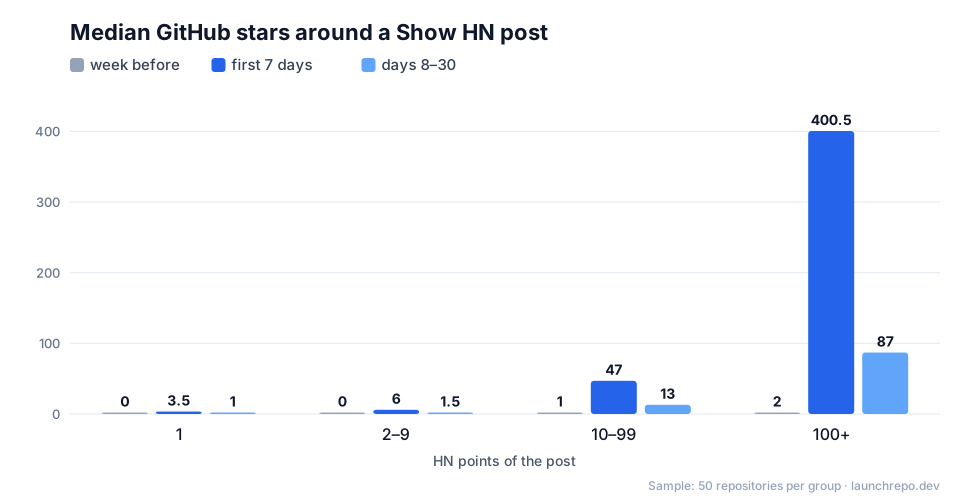
| HN points of the post | Repo posts in the dataset | Median stars, week before | Median stars, first 2 days | Median stars, first 7 days | Median stars, days 8–30 | Got 10+ stars in week 1 |
|---|---|---|---|---|---|---|
| 1 | 4,988 | 0 | 2 | 3.5 | 1 | 24% |
| 2–9 | 9,371 | 0 | 4 | 6 | 1.5 | 32% |
| 10–99 | 1,193 | 1 | 40 | 47 | 13 | 82% |
| 100+ | 307 | 2 | 244.5 | 400.5 | 87 | 98% |
Three things stand out:
- Stars follow interest. Posts that the community voted up brought far more stars. Most posts land in the first two rows, so a typical repository post brings a handful of stars, not hundreds.
- The bump is front-loaded. Most of the first week’s stars arrive on the first two days. Across the four groups, the median repository got between 43% and 70% of all stars since the post in that first week.
- It does not continue by itself. Days 8 to 30 add far less than the first week. One launch is a start; steady reasons to come back keep stars coming.
Limits, stated plainly: this is an observation, not an experiment. Projects that get many points are also more interesting, and other promotion in the same days counts too. GitHub’s API reports current stars, so stars later removed are missing. Its day boundaries are not exactly UTC, so a window can be off by up to a day. The sample has 50 repositories per group, not the full population.
What reliably earns stars
Put together, the documentation, the survey and our data point to the same few levers. All of them work by making the project more useful or easier to find.
| Lever | Why it works | Evidence |
|---|---|---|
| A README that converts in one screen | Visitors who understand the project in seconds bookmark it or try it | Bookmarking was a top reason to star (51.1%) |
| A launch where your users are | A post that resonates brings the biggest single wave of stars | Our measurement; most maintainers of fast-growing projects in the 2018 survey linked the growth to posts on social sites, mostly Hacker News |
| Keep shipping | Releases, fixes and answers give people reasons to return and share | Maintainers named low activity as the main reason for slow growth (53.8%) |
| Be findable on GitHub | Topics and a clear description put you in topic pages and search | GitHub’s topic documentation |
| Curated lists and communities | A place in a fitting awesome list or ecosystem forum keeps pointing to you | Our open source distribution plan |
| Ask once, with no reward | A friendly line such as “star to follow releases” reminds happy users | Asking is fine; rewards and swaps are not |
The distribution plan for open source maintainers turns these levers into a four-week checklist with a free plan builder, including GitHub’s topic rules and the exact awesome list requirements.
What to skip
- Buying stars or joining star exchanges. Against GitHub’s rules, easy to detect, and harmful to long-term reach, as shown above.
- Asking friends to vote on Hacker News. Hacker News says it plainly: “Please don’t ask friends to upvote or comment.” The same honesty applies to stars.
- Counting stars as users. Stars are a public signal of interest, not usage. Track installs, issues from new people and returning visitors as well.
Where LaunchRepo fits
LaunchRepo works on the part of reach that is pure effort: listing your product or project website in directories and on launch platforms. Your coding agent prepares and submits the listings from one product brief, and a tracker shows which ones are live. Its agent instructions tell the agent not to manufacture votes or comments; LaunchRepo never stars, votes or reviews on your behalf. The stars stay where they belong: with people who found your work useful. If you are building for developers, the page on promoting developer tools shows how this fits a broader launch, and the pricing page has the details.
Frequently asked questions
How do I get more stars on GitHub?
Make the project useful and easy to understand, then show it to the people who need it. A clear README with a quick start, a launch in the community where your users are, regular releases and good GitHub topics bring real stars. Asking happy users once, without a reward, is fine.
Is buying GitHub stars allowed?
No. GitHub’s Acceptable Use Policies forbid rank abuse, such as automated starring, and taking part in markets for inauthentic activity. A study of 6 million suspected fake stars found that most repositories involved had been deleted.
Do bought stars help a repository grow?
Only briefly. The ICSE 2026 study found a small effect on real stars within about two months, five times smaller than that of real stars, and a negative effect after that.
How are fake GitHub stars detected?
The study looked for two patterns: throw-away accounts whose only activity is a single star, and groups of accounts that star the same repositories within the same short window. GitHub also removes fraudulent accounts and repositories.
How many stars does a Show HN post bring?
In our sample of 200 repositories, the median in the first seven days was 3.5 stars for posts with 1 point, 6 for 2–9 points, 47 for 10–99 points and 400.5 for 100 points or more. Most of those stars came in the first two days.
Does LaunchRepo get me GitHub stars?
Not directly, and it does not star or vote for you. LaunchRepo lists your product website in directories and on launch platforms, which brings visitors who may then star the project if they find it useful.
Sources, checked on 1 October 2026: GitHub Docs, “Saving repositories with stars” and “Classifying your repository with topics”; GitHub Acceptable Use Policies; GitHub Changelog, “Upcoming access restrictions to public API endpoints and UI views” (30 June 2026); GitHub REST API, “Get repository star history”; Hao He et al., “Six Million (Suspected) Fake Stars in GitHub”, ICSE 2026 (arXiv:2412.13459v2); Hudson Borges and Marco Tulio Valente, “What’s in a GitHub Star?”, Journal of Systems and Software 146 (2018); Hacker News, Show HN guidelines; our own measurement of 200 repositories from the public Show HN dataset (method above); LaunchRepo agent instructions.